Distribution centers don’t have a waste problem. They have a waste volume problem.
The waste itself — cardboard, plastic packaging, wood pallets, trash bags, mixed materials — is predictable. It’s generated every day in large quantities, and it all needs somewhere to go. The issue begins when that waste winds up in open-top, roll-off dumpsters. It piles up unevenly, traps air, and fills the container long before it’s even close to actual capacity. Because of this, dumpster hauls happen too early, too often, and at full price every time.
For an operation built around moving goods as efficiently as possible, reactive waste management is one of the most avoidable sources of cost and disruption for distribution centers nationwide.
Why Waste Management Is a Bigger Deal in Distribution Centers
All industries deal with waste. It’s often a larger issue for distribution centers, due to the amount and types of commercial waste generated, and tight operational pressures.
A typical distribution facility processes enormous volumes of trash, including cardboard, shrink wrap, packaging, and pallets every day. That waste volume is directly tied to a company’s throughput — the more goods moving through the facility, the more packaging waste coming off those goods. During peak seasons, promotional pushes, or high-volume shipping periods, that waste can accumulate faster than dumpster schedules account for.
The result? A set of problems that’s likely all too familiar to you and your team: dumpsters fill up before the next scheduled haul; waste piles up and spills over around the container; loading docks and other high-traffic areas are cluttered with materials waiting to be handled. At this point, waste isn’t just a cost headache — it’s an operational nightmare. Congestion around dumpsters competes with inbound and outbound freight. Overflowing containers create safety concerns. And emergency hauls, called in to help clear the backlog, cost more than scheduled service and add more truck traffic to an already busy yard.
Distribution center waste management requires a solution that keeps pace with operations, not one that reacts to them.
The Cardboard and Packaging Problem
Cardboard is the dominant waste stream in most distribution centers, and it’s one of the least efficient materials to manage without proper compaction.
Boxes take up significant space, even when workers take extra time to break them down. Toss them into the dumpster, and they quickly rob the container of valuable space. Add to that shrink wrap and plastic packaging, and those lightweight materials billow and bunch around the cardboard, filling every available gap with nothing but air. A dumpster that looks full of cardboard is likely only holding a small fraction of its actual weight capacity.
Wooden pallets and crates only compound the problem. Because they are so bulky and nearly impossible to stack efficiently in an open-top container, just a few pallets or specialty crates take up a disproportionate amount of dumpster space.
The net effect is that distribution centers are often paying to haul containers that look full, but in reality are nowhere near their weight limit. Every one of those hauls is a cost that onsite waste compaction could have prevented entirely.
How Mobile Waste Compaction Fits Into Distribution Center Operations
The reason mobile waste compaction works particularly well for distribution centers is that it’s purpose-built to tackle the waste problem without adding to the operational load.
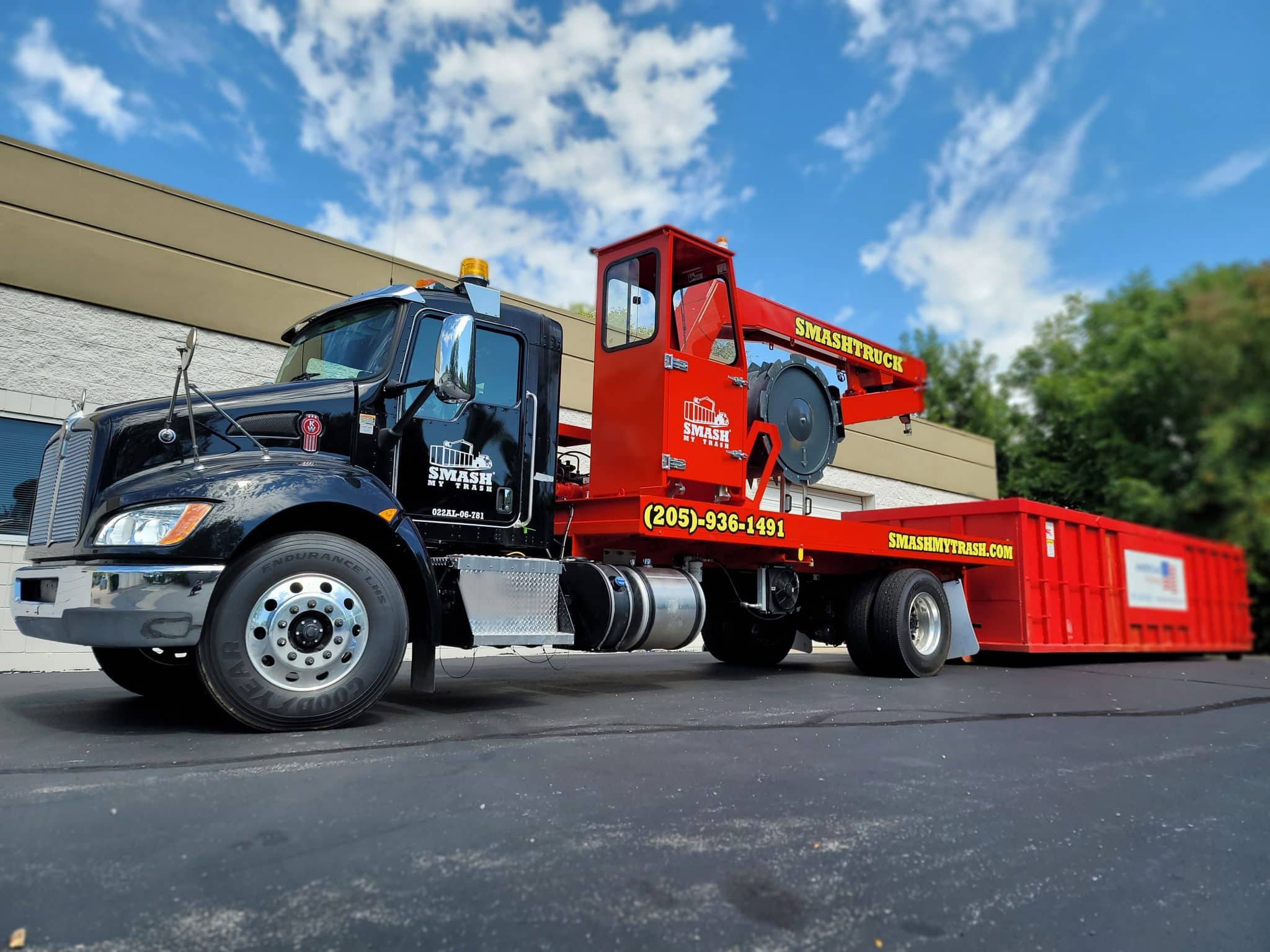
A Smash My Trash® Smash Truck® arrives at your facility, and we safely compact your waste inside existing open-top dumpsters. No new equipment to install. No employees to cross-train. No changes to your operations. A smash typically takes about 10 minutes per dumpster, and the service is scheduled around your facility’s needs, not the other way around. We fit right into your current hauling efforts.
By eliminating air pockets and reducing waste volume up to 70%, the service creates significantly more usable capacity in each container. Your team keeps filling. We come back and compact again. When the dumpster is genuinely full, we let you know it’s time to coordinate a haul. The entire process becomes more predictable, and your number of hauls goes down substantially.
For a distribution center running on tight schedules, that predictability matters. Fewer hauls mean fewer unexpected charges, less yard congestion from hauling trucks, and less time spent on waste coordination by your operations team.
The Operational Benefits Beyond Cost Savings
The cost savings from reducing dumpster hauls are the most visible benefit, but they’re not the only perk.
Cleaner loading docks and yards. When dumpsters fill up slowly and predictably, waste doesn’t pile up around them. Loading dock areas stay cleaner, access points stay clear, and the facility looks and operates the way it’s supposed to.
Better personnel and property safety. Overflowing dumpsters and cluttered workspaces increase the risk of preventable incidents. Compacted, contained waste is easier to manage and reduces the safety concerns that come with overflow. This is especially relevant for operations teams managing EHS compliance.
Less burden on your staff. Managing commercial waste takes time — tracking dumpster fill levels, calling the hauler, and managing schedules. When mobile compaction brings that frequency down and Smash My Trash monitors the entire process, your team spends less time thinking about trash and more time focused on throughput.
What the Waste Numbers Look Like
Distribution centers that implement commercial waste compaction services typically see a meaningful reduction in how often hauls need to happen. Containers that were being pulled weekly or even daily start going significantly longer between hauls. The waste costs that seemed fixed — hauling fees, fuel surcharges, tonnage charges, add-on fees — start to come down.
Smash My Trash customers across the distribution industry typically save around 15–20% on total waste costs after accounting for hauling fees and the cost of the compaction service. For high-volume facilities running multiple dumpsters, those savings compound quickly.
For facilities considering replacing their current hauler, or looking to simplify the entire waste management relationship — mobile compaction and hauling from a single vendor — Smash + Haul is worth exploring. It combines mobile waste compaction with coordinated dumpster hauling into one streamlined service, one point of contact, and one less headache.
Is Your Distribution Center a Good Fit for Mobile Waste Compaction?
Mobile waste compaction for distribution centers benefits facilities that generate regular, high-volume waste and utilize open-top, roll-off dumpsters. If your operation checks those boxes, the service is likely to deliver measurable results quickly.
The service is also straightforward to implement. Smash My Trash works alongside your existing setup and can be up and running as soon as the next day in most markets.
Not sure if it’s the right fit for your specific operation? That’s an easy conversation. The local Smash My Trash team will take a look at your waste flow and give you a straight answer.
Ready to Reduce Hauls and Improve Your Distribution Center’s Waste Operations?
Smash My Trash eliminates unnecessary hauls for distribution centers across the country, lowers total waste costs, and keeps facilities running cleaner and more efficiently. No equipment, no disruption, and measurable results from the first visit.
Schedule a risk-free demo smash and see the impact for yourself.