At some point in the commercial waste management evaluation process, most facilities managers ask the same question: Should we look into a stationary compactor, or does mobile waste compaction make more sense for our operation?
It’s a legitimate question, and it deserves a straight answer.
While stationary compactors are the right call for certain operations, mobile waste compaction is the right call for many others.
The difference largely comes down to your waste stream, your infrastructure, your dumpsters, and how much manual labor you’re willing to take on to manage your waste.
Here’s a clear look at how the two options compare when making this important business decision.
What is a Stationary Dumpster Compactor?
A stationary compactor is a fixed piece of equipment installed permanently at a facility. It uses a hydraulic ram to force waste through a sealed container attached to the machine. The compactor and its container are matched, meaning you can’t use it to compact waste in any dumpster.
Stationary compactors are found in large retail environments such as shopping malls, office parks, and other shared facilities that generate large volumes of waste.
For these specialized use-cases, the large investment and long-term commitment make sense. For most commercial operations with open-top roll-off dumpsters, it’s a different story.
The Real Cost of Going Stationary
The upfront number is the first thing most people notice, and it’s significant. Whether renting or purchasing, a stationary compactor unit and required accessories can cost anywhere from $15,000 to $100,000 or more, depending on size, capacity, and service agreements. Often, this is just for installation. Depending on the length of a contract, prices fluctuate significantly.
Getting a stationary compactor up and running typically requires:
- Dedicated physical space. These machines are huge. They need a permanent footprint at your facility, which means giving up usable space that won’t be coming back.
- Electrical infrastructure. Stationary compactors demand lots of reliable electrical power. If your facility doesn’t already have the right electrical setup in place, that’s an additional cost before the machine can even turn on.
- Permits and construction. Depending on your facility and local requirements, installation may require permits, site work, and contractors.
- Employee training. Someone on your team needs to know how to operate the unit, sort waste appropriately, diagnose issues, and follow safety protocols. That training takes time and effort, increases safety risks, and the responsibility stays in-house.
- Ongoing maintenance. Stationary compactors can be troublesome. Hydraulic systems require regular servicing. When something goes wrong, and eventually it will, repairs – and downtime – can be costly.
None of this is a dealbreaker for the right operation. But for a business already using an open-top dumpster that gets hauled regularly, it’s a significant commitment to solve a problem that has a simpler answer.
Introducing Mobile Waste Compaction
Mobile waste compaction is a fundamentally different model. Rather than installing equipment at your facility, the equipment comes to you.
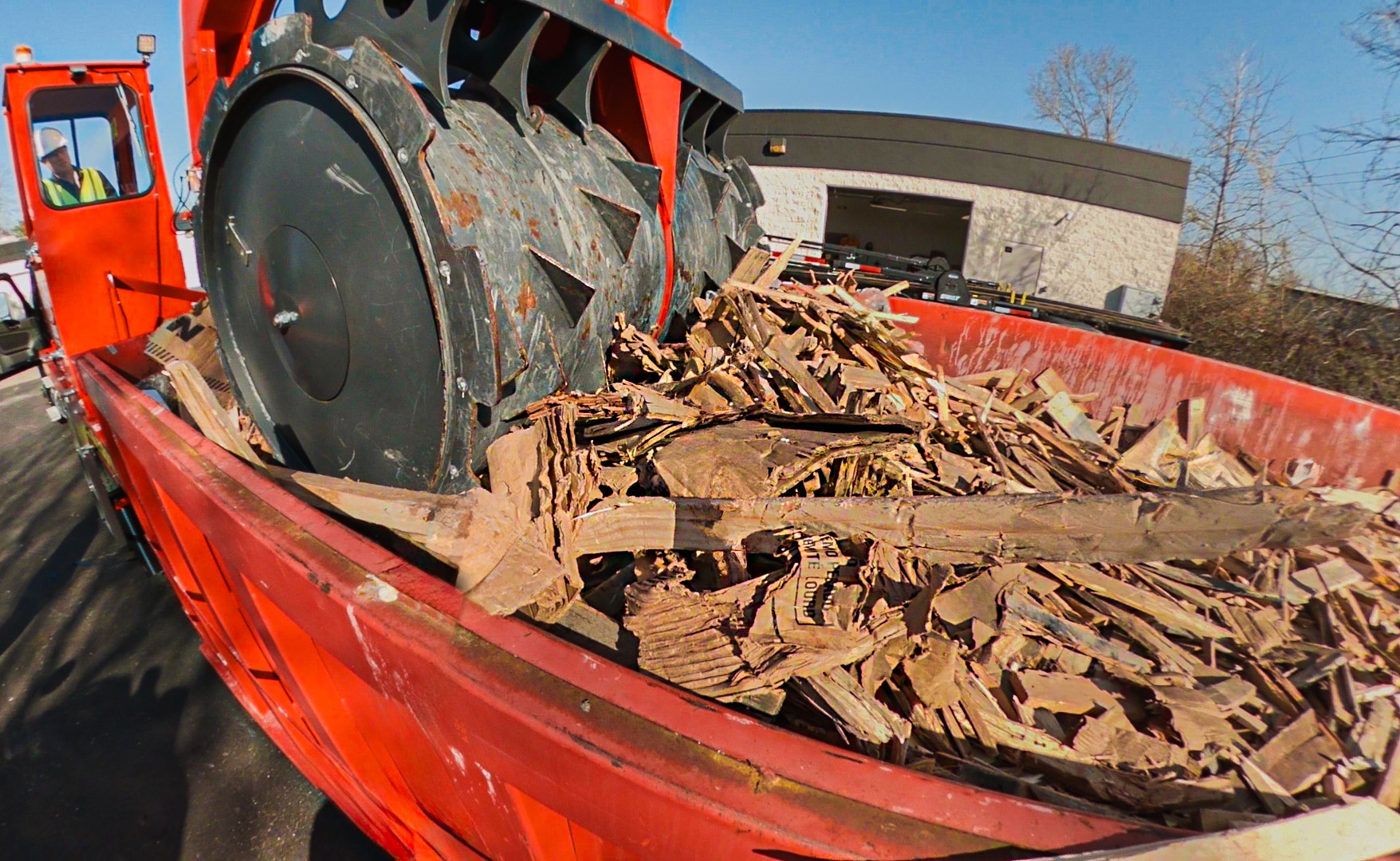
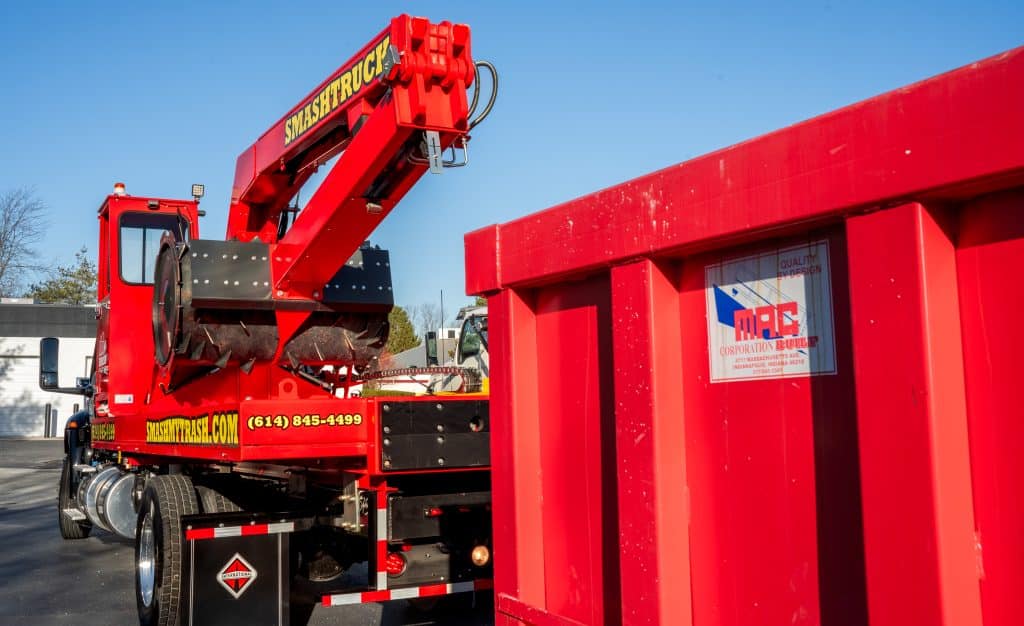
The model is simple: instead of buying and installing all that compaction infrastructure at your facility, Smash My Trash brings our specialized on-board compactor right to you. A Smash Truck® shows up, compacts waste inside your existing dumpster, and leaves – that’s it! Your operation doesn’t pause. Your team doesn’t get involved. Nothing about your facility changes except how long your dumpster stays on-site before it needs a haul.
Our mobile compaction reduces waste volume by up to 70% in a single visit, which means your dumpster holds significantly more material before it actually fills up. Your number of hauls goes down, and so does your total cost of waste management, typically by around 15–20%.
With Smash My Trash, the compaction process looks completely different than stationary compactors:
- No capital investment. Our service runs as an operating expense, not a capital cost.
- No space commitment. Your facility stays exactly as it is. You can even keep your existing dumpsters.
- No training or staffing burden. We manage the entire process, while your team focuses on what matters most – their own work.
- No maintenance. Since there is no new equipment to procure, there’s nothing to break down or maintain.
- No electrical setups. No power hookups, no infrastructure changes, no contractors or energy costs required.
- Flexible and scalable. Our service frequency adjusts as your waste volume changes. There’s nothing to uninstall if your operation shifts.
Why Roll-Off Dumpster Users Need a Better Solution
Here’s another part of this comparison that often gets overlooked: stationary compactors require their own dedicated containers. They aren’t designed to work with standard open-top, roll-off dumpsters.
If your facility uses open-top roll-off containers, which is the case for the vast majority of commercial businesses across manufacturing, distribution, logistics, and construction, a new stationary compactor doesn’t slot into that setup. It only adds to it, which means changing your entire waste arrangement, your hauling relationship, as well as the physical and energy footprint of your facility .
Mobile waste compaction, by contrast, works right alongside what you already have. The dumpster stays. The hauler stays. The only thing that changes is how efficiently the dumpster gets used. In other words, more trash is disposed with fewer hauls.
A Side-by-Side Comparison of Stationary Compactors Vs. Mobile Waste Compaction
| Stationary Compactor | Mobile Waste Compaction | |
| Upfront cost | $15,000–$100,000+ | None |
| Installation required | Yes: Equipment, electrical, space, permits | No |
| Works with open-top dumpsters | No | Yes |
| Employee training needed | Yes | No |
| Ongoing maintenance | Yes | No |
| Flexibility | Low — fixed installation | High — adjusts to your needs |
| Implementation timeline | Weeks to months | As soon as next day |
| Best for | High-volume, enclosed waste streams | Open-top dumpster users across industries |
What’s the Best Dumpster Compaction Method for Your Business?
If your operation generates extremely high volumes of waste, and you have the budget, space, and infrastructure to support a permanent installation, a stationary compactor may be a smart long-term investment.
For most commercial businesses that already rely on open-top, roll-off dumpsters, simple on-site mobile compaction delivers significant waste volume reduction without any of the complications.
Ready to See What Mobile Waste Compaction Can Do for Your Operation?
With Smash My Trash, commercial businesses across the country are reducing unnecessary hauls, lowering total waste costs, and getting significantly more out of every open-top dumpster, without any equipment, installation, or operational disruption.
Schedule a risk-free demo smash and see the impact for yourself.